|
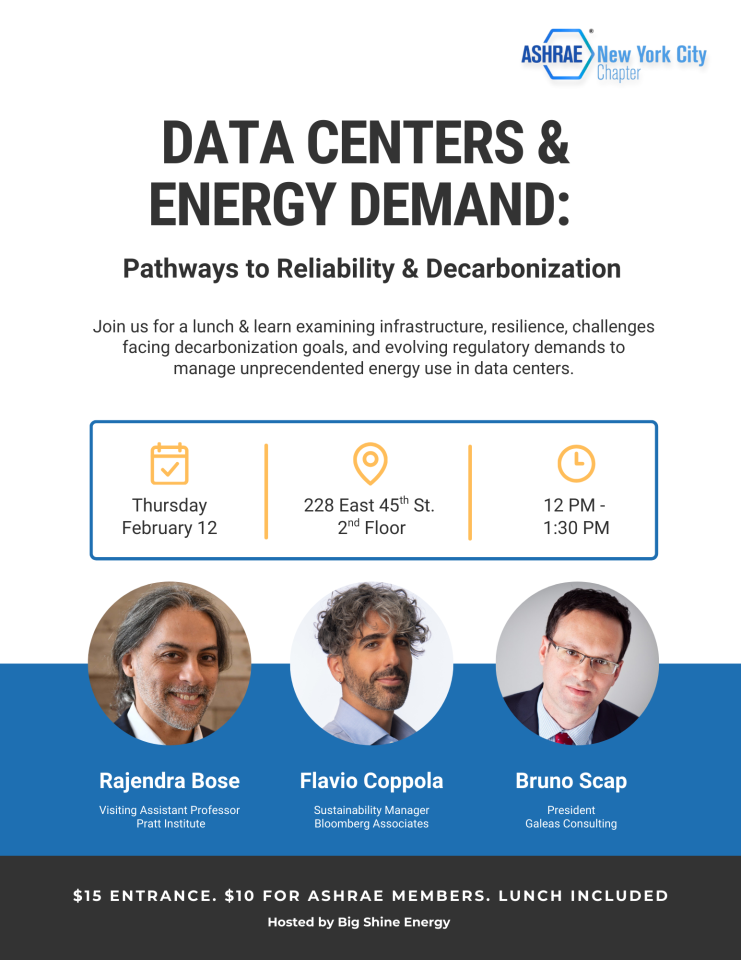
Data centers are being rapidly developed to support the expansion of AI and cloud-based services, placing unprecedented demands on energy, utility, and infrastructure systems. As these facilities grow in scale and density, aligning reliability requirements with decarbonization and climate mandates has become a critical challenge.
Join us for a lunch & learn exploring how policy considerations, computing requirements, and building systems intersect in the planning, design, and operation of both large and urban data centers. The discussion will highlight emerging strategies to manage escalating energy demand while advancing efficiency, resilience, and emissions reduction goals.
Speakers will examine the need for close coordination among computing professionals, facilities teams, utilities, and policymakers to deliver compliant and future-ready data center environments. Topics will include decarbonization plans, grid infrastructure, non-standard fiber optic networks, backup power and load-shifting strategies, specialized fire suppression systems, and the evolving regulatory landscape.
Date & Time: Thursday, February 12 | 12:00 PM – 1:30 PM
Location: Big Shine Energy | 228 East 45th Street, New York, NY
Program Schedule
Speaker presentations: 12:00 – 1 PM
Networking and lunch: 1 – 1:30 PM
Speakers
Flavio Coppola, Sustainability Manager for Bloomberg Associates
Flavio specializes in urban decarbonization and climate resilience. With an extensive background in international climate policy and urban economics, he has successfully led initiatives for high-profile clients and partners including Google and Amazon. A graduate with distinction from The London School of Economics (LSE), Flavio is dedicated to fostering public-private partnerships that accelerate global clean energy transitions.
Bruno Scap, President, Galeas Consulting
With more than twenty-five years of experience designing and managing IT infrastructure, Bruno advises corporations and research institutions on IT strategy for energy-intensive computing environments. His work includes high-density electrical systems, cooling strategies, operational resiliency, and the integration of IT and building systems for mission-critical facilities.
Rajendra Bose, Visiting Assistant Professor, Pratt Institute
Raj has over fifteen years of experience in academic scientific computing, including building and leading teams at Columbia University and other research organizations. His work focuses on computational systems supporting research, with current interests in environmental and climate science initiatives in New York City through Pratt Institute’s partnership with the New York Climate Exchange.
|